Maritime Academy

Fertilizers — Exact declaration required — Hold Preparation & Cleaning

Urea, DAP/MAP, potash and ammonium nitrate do not share one method.

Scope, source date and conditions of use

Source review: 17 October 2026 · General preparation and cleaning reference. Selecting a cargo does not authorise carriage, hold acceptance, enclosed-space entry or discharge. Use the exact declaration, vessel SMS, current schedule, manufacturer instructions and company-approved work plan.

Fertilizers — Exact declaration required — AI-generated illustrative cargo-group image
Illustrative cargo-group image · AI-generated. Does not verify an exact product, sample or particle size.

KNOW THE CARGO · SEE THE CHECKS · BUILD YOUR FILE

Fertilizers — Exact declaration required

Urea, DAP/MAP, potash and ammonium nitrate do not share one method.

Choose your next step. Detailed checks and sources expand under the relevant heading.

CARGO REQUIRING A SPECIFIC METHOD
Do not infer a generic water wash or chemical recipe; verify the exact product and approved method.

Image sources and scope

Cargo images are illustrative. Shared hold and coating photographs introduce inspection topics; they do not show carriage of the selected cargo or completion of an operation. They are not a before/after comparison.

VileGecko · Hold photograph · ImagePerson · Industrial surface photograph · CC BY-SA 4.0. Converted to WebP, photos not cropped; small previews are shown in the interface.

Change previous / following cargo

Add the cargo sequence to this file

TO LOAD NOWFertilizers — Exact declaration required
What does this selection show?

This selection is not a chemical-compatibility matrix or a loading clearance; it brings the selected cargo checks together.

CARGO TRANSITION WORK FILE

Previous cargo unknown → Fertilizers — Exact declaration required

Existing checks from the selected profiles are assembled here; this is not a validated transition-specific chemical recipe or carriage-compatibility decision. Entered information is not submitted or stored on the server and is lost on leaving the page.

Previous cargo is unknown. Establish cargo history and remaining product before choosing a cleaning method.

PREVIOUS RESIDUENEW CARGO REQUIREMENTSDOCUMENT AND FIELD CHECKS
Cargo to load now: verify preparation · Fertilizers — Exact declaration required

Urea, DAP/MAP, potash and ammonium nitrate do not share one method.

  1. Obtain full BCSN, composition and SDS.
  2. Verify product-specific cleanliness, dryness and segregation requirements.
  3. Assess combustible contamination and heat separately for ammonium-nitrate products.
  4. Compare ammonium-nitrate content, organic contamination and segregation against the exact declaration.
  5. Obtain method approval where product SDS conflicts with coating/following-cargo requirements.

Profile sources: MS Amlin · Carriage of fertilizers ↗ IMO · IMSBC / Grain Code distinction ↗ UK P&I · Hold preparation and cleaning, chapter 17 (2023) ↗ IMO · MSC.581(110), 2025 enclosed-space recommendations ↗ IMO · MARPOL Annex V / cargo residues ↗

After this cargo is discharged: plan cleaning · Fertilizers — Exact declaration required

Urea, DAP/MAP, potash and ammonium nitrate do not share one method.

  1. Do not add chemicals to unidentified residue.
  2. Do not start water/chemical cleaning without product-specific verification.
  3. Plan subsequent-cargo and waste acceptance in writing.
  4. Record caking, colour and heating changes; do not resolve these by assuming a single product.
  5. Do not choose acid, alkali or oxidising cleaners without the relevant manufacturer method.

Profile sources: MS Amlin · Carriage of fertilizers ↗ IMO · IMSBC / Grain Code distinction ↗ UK P&I · Hold preparation and cleaning, chapter 17 (2023) ↗ IMO · MSC.581(110), 2025 enclosed-space recommendations ↗ IMO · MARPOL Annex V / cargo residues ↗

Open actions and responsibility

Statuses are a record, not a safety score, cleanliness acceptance or loading authorisation. Record a reason for not-applicable items.

Open record fields · 6 check headings
1 · Exact commercial identity, cargo declarations and cargo history
2 · Written cleanliness and acceptance requirements for the next cargo
3 · Entry, atmosphere checks, isolation and safe-access plan
4 · Coating compatibility; if used, exact chemical, current SDS/PDS and maker conditions
5 · Water, equipment, time and residue/wash-water management
6 · Final inspection, required tests and acceptance/authorisation responsibility

Refer unresolved or unapproved items to the responsible company personnel. This file does not replace SMS permits and acceptance processes.

Profile source review: 2026-10-17 · File generated: 2026-10-18 06:08 +03

VISUAL FIELD GUIDE

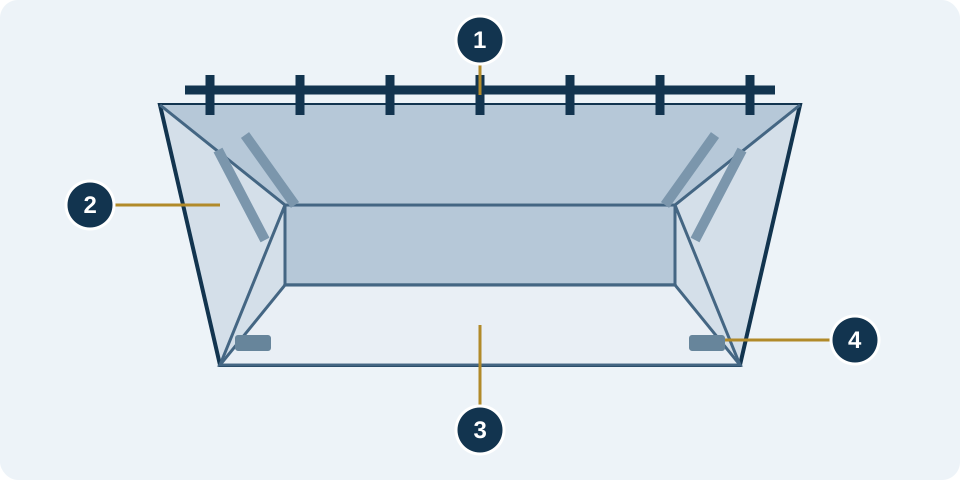
Where to look inside the hold

Open a numbered heading to inspect the highlighted area and its check note together. The drawing does not authorise access or entry.

Numbers correspond to the adjacent check headings. Not an actual vessel plan. 1 2 3 4 5 6 7 8
Original cutaway, not to scale. Numbers identify inspection areas, not hull construction, work platforms or rescue arrangements. Inspect upper areas only through approved safe access/observation methods.
1Hatch underside & coaming

Check deposits that may fall back from hatch undersides and channels. Keep drainage clear.

Record: Hatch underside / channel photograph
2Underdeck brackets

Do not infer clean upper recesses and blind faces from a clean tank top.

Record: Upper-surface observation record
3Frames & hopper faces

Check front and back faces separately; record loose deposits, scale and flaking paint.

Record: Blind-face inspection
4Ladders & supports

Check behind rungs and supports for residue; do not use damaged access fittings.

Record: Access defect / work order
5Tank top & manhole edges

Check plate edges and cover recesses for solids, water and impact damage.

Record: Closing tank-top photograph
6Bilge well & strainer

Inspect wells and protection; do not leave fine sludge within fixed piping.

Record: Well / strainer check
7Pipes, guards & vents

Include surfaces behind pipes and guard recesses in inspection coverage.

Record: Behind-pipe / guard record
8Surface test area

Assess an approved small representative patch; do not automatically extrapolate to the whole hold.

Record: Before/after and coating findings

UK P&I · Chapter 17 ↗ · West P&I · Inspection & cleaning ↗

SIX-STAGE WORK PLAN

Sequence, evidence and stop points

This sequence requires product/specialist instructions. The flow below is for planning and verification only; no generic wet-cleaning procedure is provided.

Define the task01

Define the task

Record: Cargo declaration + written acceptance criteria

Stop / reassess: Do not select a method with unknown residue or standard.

How should I assess this?

Write down previous residue, intended cargo and required standard. Plan water, equipment, time and waste arrangements accordingly.

Reference document ↗
Establish safe work arrangements02

Establish safe work arrangements

Record: Permit / measurements / equipment records

Stop / reassess: Do not enter if atmosphere, access or rescue conditions are unmet.

How should I assess this?

Under the SMS, verify risk assessment, permit, isolation, atmosphere testing, communications and rescue.

Reference document ↗
Separate and recover residue03

Separate and recover residue

Record: Residue type + collection / disposal route

Stop / reassess: Do not start generic water/chemical cleaning on unknown or reactive residue.

How should I assess this?

Distinguish loose solids, oily film, adherent deposits and reactive material. Establish a suitable collection method.

Reference document ↗
Verify product and method04

Verify product and method

Record: Product / batch + dilution + contact time

Stop / reassess: Stop for coating softening, colour transfer or an unexpected reaction.

How should I assess this?

Match exact-product SDS/PDS with coating and following-cargo requirements. Record an approved patch trial and result.

Reference document ↗
Verify rinsing and dryness05

Verify rinsing and dryness

Record: Water source + rinse / drying observations

Stop / reassess: Do not close the stage under time pressure if product/cargo conditions are unmet.

How should I assess this?

Wash/rinse only when permitted by the approved method. Check water used, remaining detergent/salt and dryness against the following cargo.

Reference document ↗
Separate final inspection from acceptance06

Separate final inspection from acceptance

Record: Before/after photographs + open items + acceptance record

Stop / reassess: Plan correction and reinspection if residue, odour, moisture or defects remain.

How should I assess this?

Reinspect the eight areas; retain photographs, open defects and required survey findings. Work completion is not cargo acceptance.

Reference document ↗

MOVE FROM READING TO INSPECTION

Explore inspection points in actual photographs

General educational photographs, not this cargo’s operation or an acceptance example. First photograph: VileGecko; second: ImagePerson, an industrial surface rather than a ship. CC BY-SA 4.0 · Photo sources and explanations

Residue and wash-water plan

Determine the cargo’s HME status and assess cleaning agents, discharge location and applicable MARPOL Annex V/local requirements. A supplier’s non-HME statement for a cleaner does not itself authorise discharge of the complete wash-water mixture. Arrange reception facilities when required and retain the applicable records.

Open the full general hold guide →

DOCUMENTS FOR THE CARGO SEQUENCE

Which product document for which residue?

Click a product name to open the manufacturer’s official SDS access page in a new tab. Search the exact product name and select the relevant country/jurisdiction and language where available. Match the current full SDS to the product on board. A product data sheet or Mini SDS does not replace the full SDS.

Review these products as alternatives; do not mix them. Manufacturer summaries below require the same product/formulation, compatible coating and company-approved work plan. Current full SDS/PDS takes precedence; a summary alone is not application approval. Reviewed 17 October 2026.

No previous cargo selected: preloading residue-cleaning products cannot yet be identified. Any documents below concern the intended cargo’s own preparation/after-discharge stages.

No ready-made chemical application package is supplied for this sequence. Exact residue, cargo, coating and reactivity information requires a company/manufacturer/specialist method.

General chemical document library →

Pre-work verification and record list

Ticks are cleared when you leave this page. Print/save the completed checklist to your own record system. Ticking items does not grant permission or acceptance.

Download the general hold checklist (PDF) ↓

Sources for this profile

Check publication dates and later changes. Club guidance, manufacturer documents and binding schedules have different roles. This file is not a complete carriage manual.

Source review: 2026-10-17

Report a document link problem (email) →

Dadaylılar Shipping

Let’s discuss your cargo.

Contact our team with the exact cargo description, quantity, ports and planned dates. Enquiries are assessed against the relevant vessel’s documents and operational suitability.